
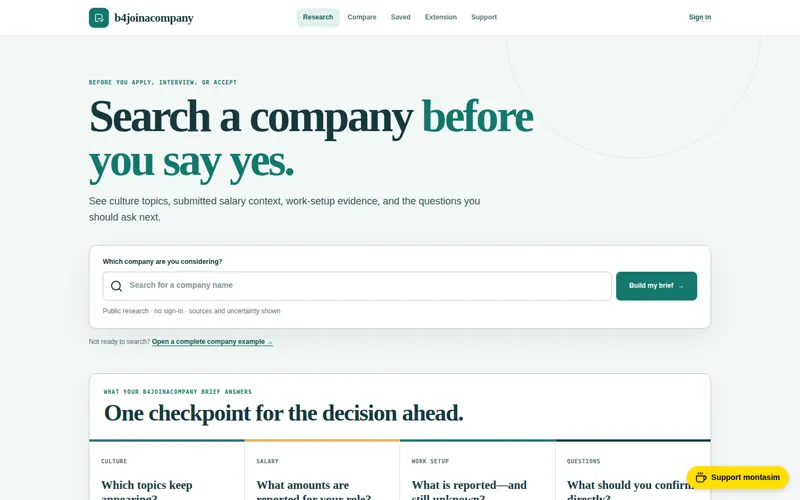
The visible feature was only the surface
Job seekers in Bangladesh often assemble company research from workplace stories, salary submissions, official pages, and interview conversations. Those sources have different levels of reliability, but conventional summaries can flatten them into an unfair good-or-bad judgment.
The system also had to respect concrete constraints. Personal workplace reports provide context, not verified statements of current company policy. Company names and salary records can be ambiguous, so fuzzy matching cannot silently publish a result. AI answers must remain bounded by retrieved evidence and still work when no model provider is configured.
My role covered product design, evidence modeling, and full-stack engineering, with responsibility for decision support, cited ai, private research, and versioned data.
I turned the constraints into boundaries
Versioned source files feed a deterministic research layer. The web product and versioned API consume the same evidence model, while private checkpoints live separately in MongoDB.
Reported, submitted, derived, and official information stay distinct, with source URLs and capture context retained for review.
Missing salary, work-arrangement, or hiring evidence appears as a gap rather than a negative score or guessed policy.
Ask retrieves a bounded company-specific evidence set, maps claims to source labels, and falls back to deterministic retrieval when providers are unavailable.
The key decision: Preserve provenance at the record level.
The implementation had to prove the model
I delivered the work across the full path: Defined the product methodology and the separation between reports, derived signals, and official facts. Built company research, comparison, cited Ask, correction, and private checkpoint workflows. Designed the versioned API shared by the website and companion browser extension. Implemented optimistic checkpoint revisions and separated private workspace data from the public evidence release.
The result is concrete: Visitors can research a company without creating an account and open original evidence for important claims. Prepared questions are generated by fixed rules, while Ask provides cited synthesis or an explicit evidence gap. Saved checkpoints retain the exact evidence version and append revisions on successful updates. The product supports comparison without producing a synthetic company score or declaring a winner.
The senior engineering lesson was that solving the visible workflow is only half the job. The architecture must also make constraints, failure modes, evidence, and ownership explicit enough for the next change to remain safe.