

The visible feature was only the surface
Developers need status-code names, categories, and lifecycle metadata without memorized numeric checks, stale hand-written lists, or a heavy dependency.
The system also had to respect concrete constraints. IANA registry state changes over time. Obsolete, temporary, and unused codes must remain distinguishable. API typing and ESM/CommonJS compatibility must not depend on live network access.
My role covered library design and package engineering, with responsibility for typed apis, compatibility, and package distribution.
I turned the constraints into boundaries
Committed IANA-derived registry and generated typed library; independently importable constants/predicates/metadata entry points; workspace-linked interactive reference and automated registry/release workflows.
Commit the registry snapshot instead of fetching at runtime, trading periodic maintenance for deterministic builds.
Preserve lifecycle metadata rather than flattening every number to "valid".
Expose separate entry points to support focused imports while retaining a complete main API.
The key decision: Commit the registry snapshot.
The implementation had to prove the model
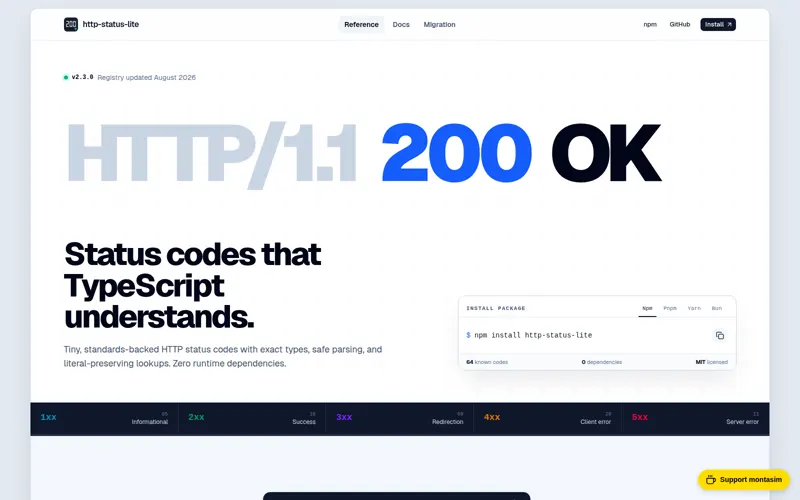
I delivered the work across the full path: Built the typed registry, lookups, parsers, and status-class predicates. Modeled permanent/temporary/obsolete/unused entries. Added generator/drift and package publishing gates. Implemented an interactive status reference that consumes the local library.
The result is concrete: Consumers can retrieve status metadata. Classify success/client/server categories. Parse and validate codes. Use a reviewable standards snapshot without runtime network access.
The senior engineering lesson was that solving the visible workflow is only half the job. The architecture must also make constraints, failure modes, evidence, and ownership explicit enough for the next change to remain safe.