
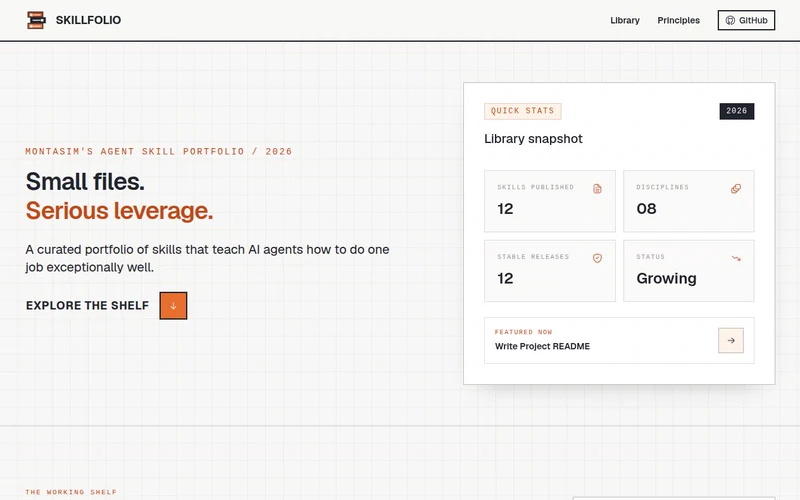
The visible feature was only the surface
Reusable SKILL.md capabilities are scattered across repositories and are difficult to compare by purpose, host compatibility, maturity, and install path.
The system also had to respect concrete constraints. Catalog facts can drift from source repositories and package releases. Remote GitHub README fetching can fail or be rate-limited. Heterogeneous Markdown must render safely and consistently without implying every skill has identical support.
My role covered agent workflow design and automation engineering, with responsibility for agent workflow, validation automation, and packaging.
I turned the constraints into boundaries
TanStack Start routes and React catalog UI; typed local catalog/search/filter model; remote README fetch/render pipeline with retry/source fallback; build-time metadata, sitemap, and Netlify deployment.
Keep discovery metadata in a curated local catalog for predictable builds, accepting explicit synchronization work.
Render source documentation while retaining direct-source fallbacks when fetches fail.
Use one featured entry and structured status/compatibility fields so comparisons remain consistent.
The key decision: Keep discovery metadata in a curated local catalog.
The implementation had to prove the model
I delivered the work across the full path: Designed catalog schema, filters, summaries, cards, and detail routes. Implemented remote README rendering and failure fallbacks. Documented the add-skill workflow and validation expectations. Added tests, sitemap generation, responsive UI, and Netlify configuration.
The result is concrete: Visitors can browse and compare skills. Open rendered documentation and canonical repositories. Inspect compatibility, version, status, and categories. Maintainers can add catalog entries through a documented, testable workflow.
The senior engineering lesson was that solving the visible workflow is only half the job. The architecture must also make constraints, failure modes, evidence, and ownership explicit enough for the next change to remain safe.