Treat relationships as graph data
Tree placement, generation labels, parent junctions, sibling grouping, and relationship views are derived from shared relationship records instead of separate presentation-only links.

A local-first family archive that combines a readable relationship graph with detailed profiles, timelines, recurring dates, version history, and complete backup restoration without requiring an account.
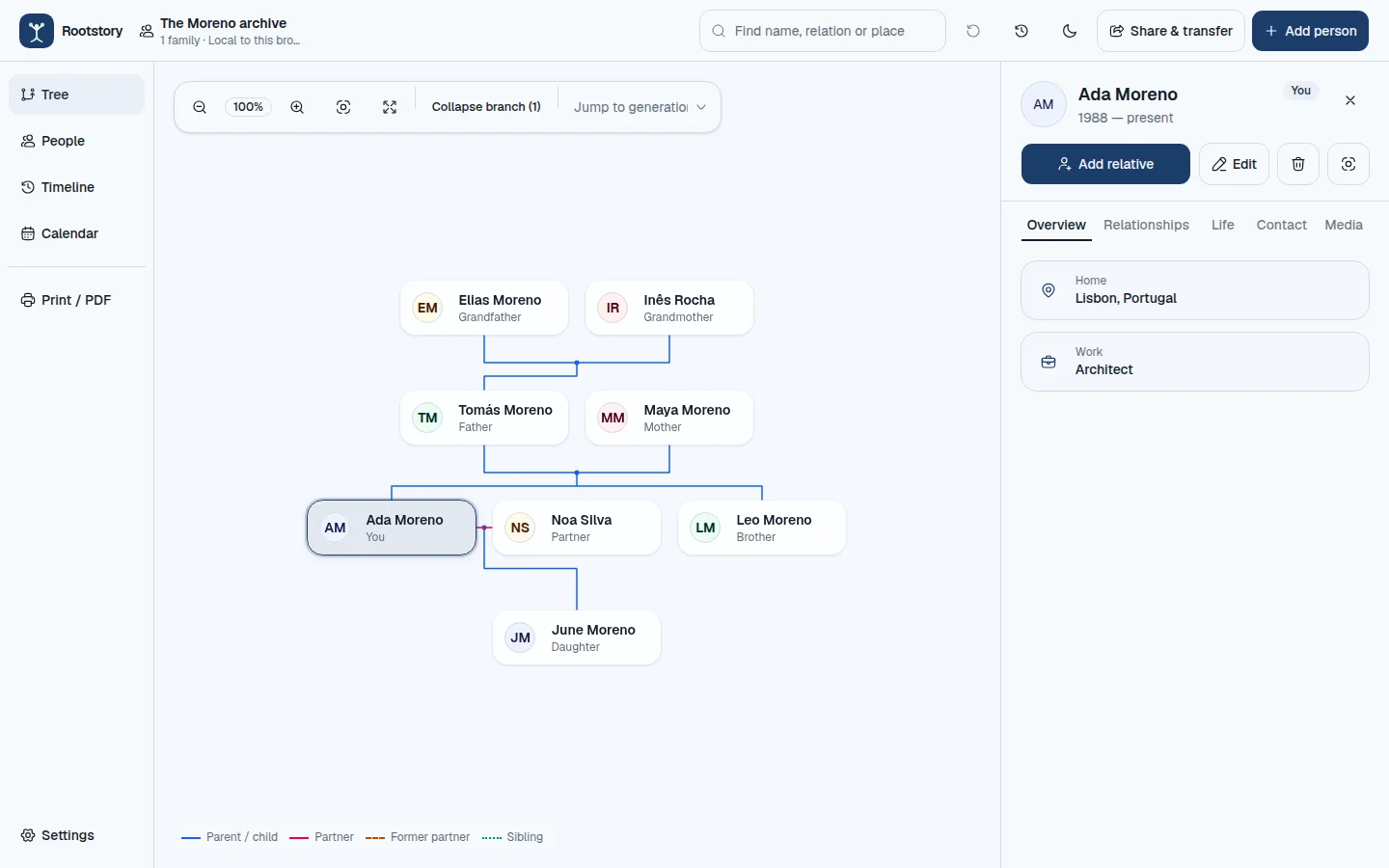
Family history becomes difficult to trust when relationships are visually ambiguous, important life details are scattered across tools, and an export cannot recreate the archive that a family carefully assembled.
Parent, child, partner, former-partner, and sibling relationships must remain visually distinct without making the tree difficult to scan.
Portraits, contact details, notes, and living-person records are sensitive, so the application stores its working archive locally and does not silently upload it.
A complete backup must preserve people, relationships, photos, private fields, sharing records, and display settings, while interoperability formats necessarily carry less information.
The workspace must remain usable across desktop and small screens while keeping navigation, profile controls, and tree exploration understandable.
Browser-local storage provides no automatic device synchronization, so users must keep complete backups if the archive matters.
TanStack Start and React render a responsive archive workspace around a typed family domain, IndexedDB persistence, versioned recovery, and explicit import/export boundaries.
Typed people and relationship records drive generation levels, relatives, life events, tree ordering, and direct parent-child connectors from one shared graph.
IndexedDB stores the active archive and recent recoverable versions, with migration support for older browser-local records.
Tree, People, Timeline, Calendar, profile, settings, and print surfaces share one responsive application shell with focused scrolling regions.
A native Rootstory archive preserves the complete model; GEDCOM, CSV, text, HTML, PDF, and iCalendar exports serve narrower interchange and presentation needs.
Tree placement, generation labels, parent junctions, sibling grouping, and relationship views are derived from shared relationship records instead of separate presentation-only links.
The product works without an account and keeps sensitive family information in the current browser unless the user explicitly downloads or imports a file.
The native backup is the restorable source of truth, while GEDCOM and spreadsheet exports are described honestly as partial interchange formats.
Parent-child, partner, former-partner, and sibling connections use distinct colors and line styles that match the tree legend.
Share your challenge, scope, and timeline to start a focused conversation.