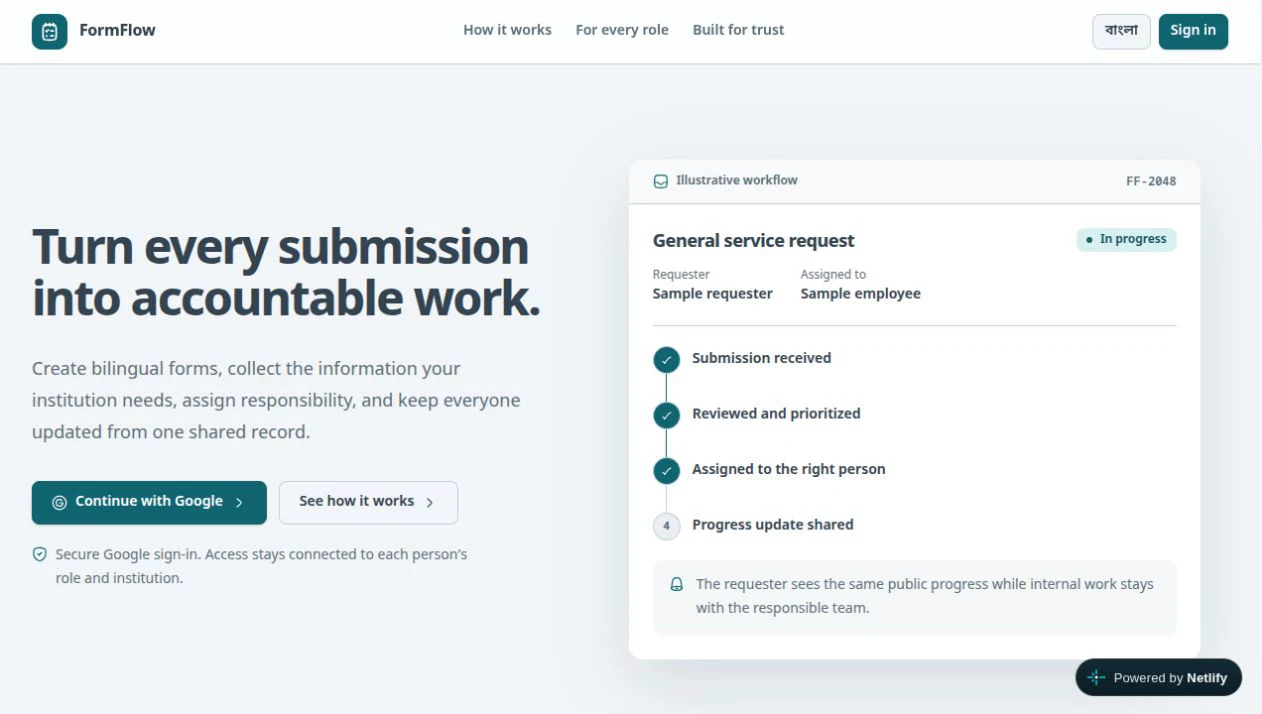
Bilingual, role-aware platform for institution-owned forms, versioned submission workflows, employee assignments, requester-visible progress, notifications, and audit history.
FormFlow is a web application created to make a real workflow clearer, faster, and easier to trust. It turns a focused product idea into something people can use, evaluate, and understand without needing to inspect the source code.
Why FormFlow exists
Institutions often manage operational requests across chat, spreadsheets, fixed forms, and verbal follow-up, separating submitted information from ownership, current status, and accountability.
The goal is not simply to add another tool. FormFlow is designed to reduce the friction around that problem and give people a more dependable way to complete the work.
What it delivers
- Institutions can define bilingual forms and operational workflows without changing application source code.
- Requesters can submit a published form, receive a tracking number, and follow requester-visible progress from one record.
- Admins and delegated Managers can review queues, assign Employees, manage people, and inspect accountable history within their institution.
- Employees can accept assigned work, record progress and evidence, and complete or return the assignment through explicit workflow states.
- Published versions, work logs, notifications, decisions, and audit events preserve a traceable history as the process evolves.
The experience
A bilingual, institution-configurable operations platform that keeps form definitions, immutable versions, assignments, progress, notifications, and audit history attached to one submission.
The project brings the important parts of the workflow into one coherent experience. Its interface and behavior are shaped around the people using it, while the implementation stays focused on predictable results and honest feedback.
What to know
Every product has boundaries. These are the most important considerations for FormFlow:
- English and Bengali must be complete interfaces, with locale-aware content and Bengali or Latin numeral handling where appropriate.
- Google identity, platform authority, and institution membership are separate security boundaries, so every protected read and mutation must be authorized on the server.
- Historical submissions must remain interpretable after an institution edits a form or workflow, requiring immutable published versions and explicit state transitions.
- Google OAuth, Neon, Resend, and Netlify depend on environment-specific configuration without moving credentials into source control.
These limitations are presented openly so visitors can understand where the project works well, what it depends on, and what may change in future versions.
Current status
Public early-stage deployment. The current release demonstrates the core value of the project and the main end-to-end experience.
My role was product design and full-stack engineering, covering multi-tenant authorization, configurable workflows, and bilingual service delivery. The related case study explains the decisions and delivery process in greater depth for visitors who want the engineering story behind the product.