
The visible feature was only the surface
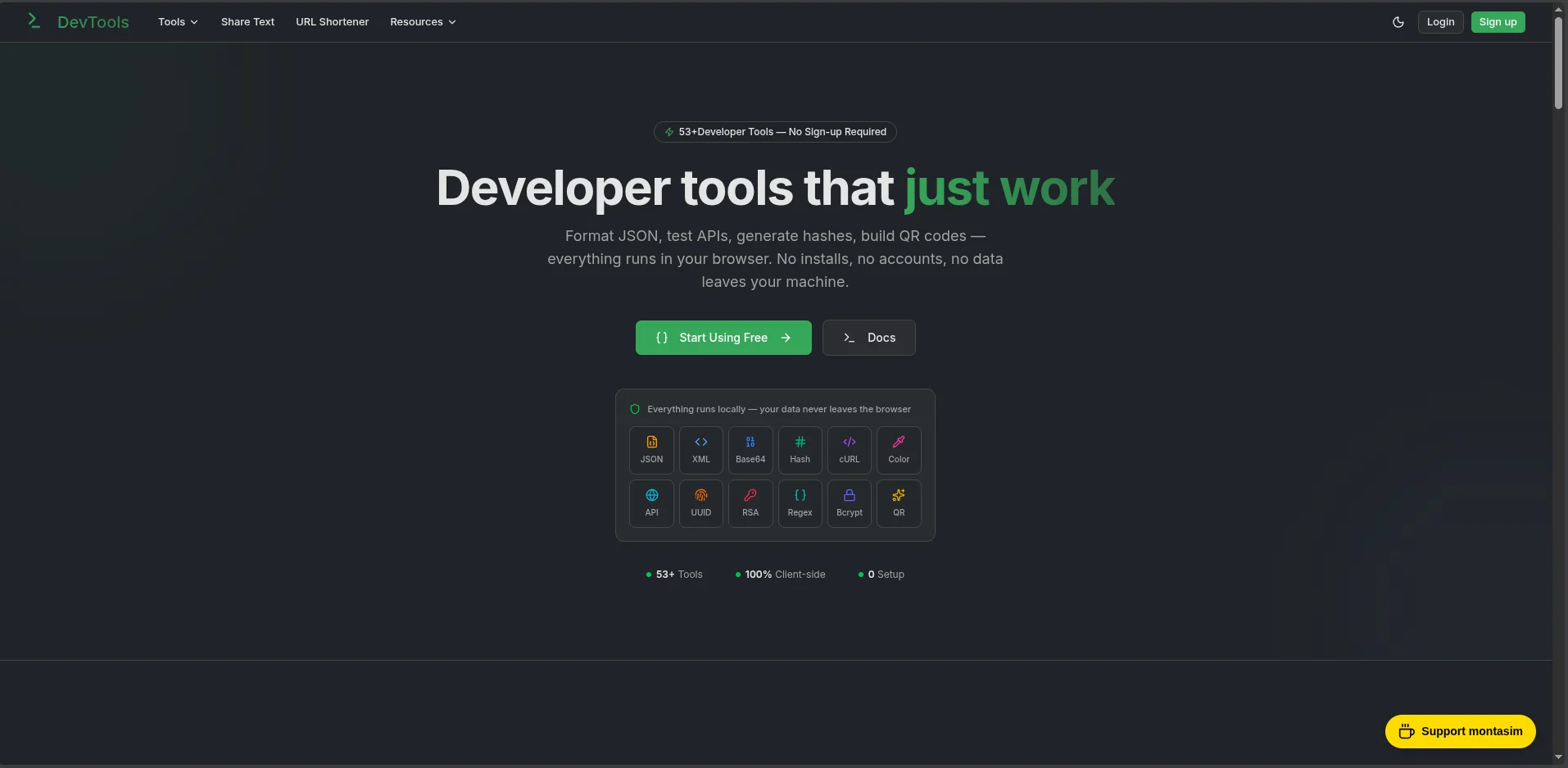
Small development tasks often send people across unrelated single-purpose websites. Each tool has a different interface, unclear privacy behavior, and no shared path for search, history, saved work, or reuse.
The system also had to respect concrete constraints. Many transformations should stay in the browser, while network diagnostics necessarily contact a target or server endpoint. A catalog with more than 50 workflows must remain quick to search, navigate, and extend without duplicating page infrastructure. Saved items, shares, webhooks, and short links introduce authentication, expiration, and persistence concerns absent from local tools.
My role covered product design and full-stack engineering, with responsibility for developer utilities, shared interaction patterns, and account-backed tools.
I turned the constraints into boundaries
A navigation registry acts as the catalog source of truth. Tool features own their tabs and logic, shared app infrastructure handles auth and storage, and route handlers isolate network and persistence work.
The navigation registry is the single source for tool discovery, reducing drift between routes, menus, and command search.
Formatters, encoders, parsers, and generators process current input in the browser; server contact is reserved for workflows that require it.
Shared layouts, tabs, editors, history, and actions let new utilities focus on their domain logic while keeping interactions familiar.
The key decision: Make the catalog declarative.
The implementation had to prove the model
I delivered the work across the full path: Designed and implemented the searchable toolbox and its shared tool interaction patterns. Built local formatters and generators alongside network diagnostics and reference utilities. Added account sync, expiring shares, short links, webhook inspection, and database-backed saved items. Established TypeScript, lint, production-build, and GitHub Actions checks for changes targeting main.
The result is concrete: More than 50 workflows are available through one catalog and command-search model. Common transformations can run without an account and without sending their current input to the server. Server-backed features add reuse and sharing without obscuring when data leaves the browser. The architecture supports both small local utilities and stateful workflows without forcing them through one execution path.
The senior engineering lesson was that solving the visible workflow is only half the job. The architecture must also make constraints, failure modes, evidence, and ownership explicit enough for the next change to remain safe.