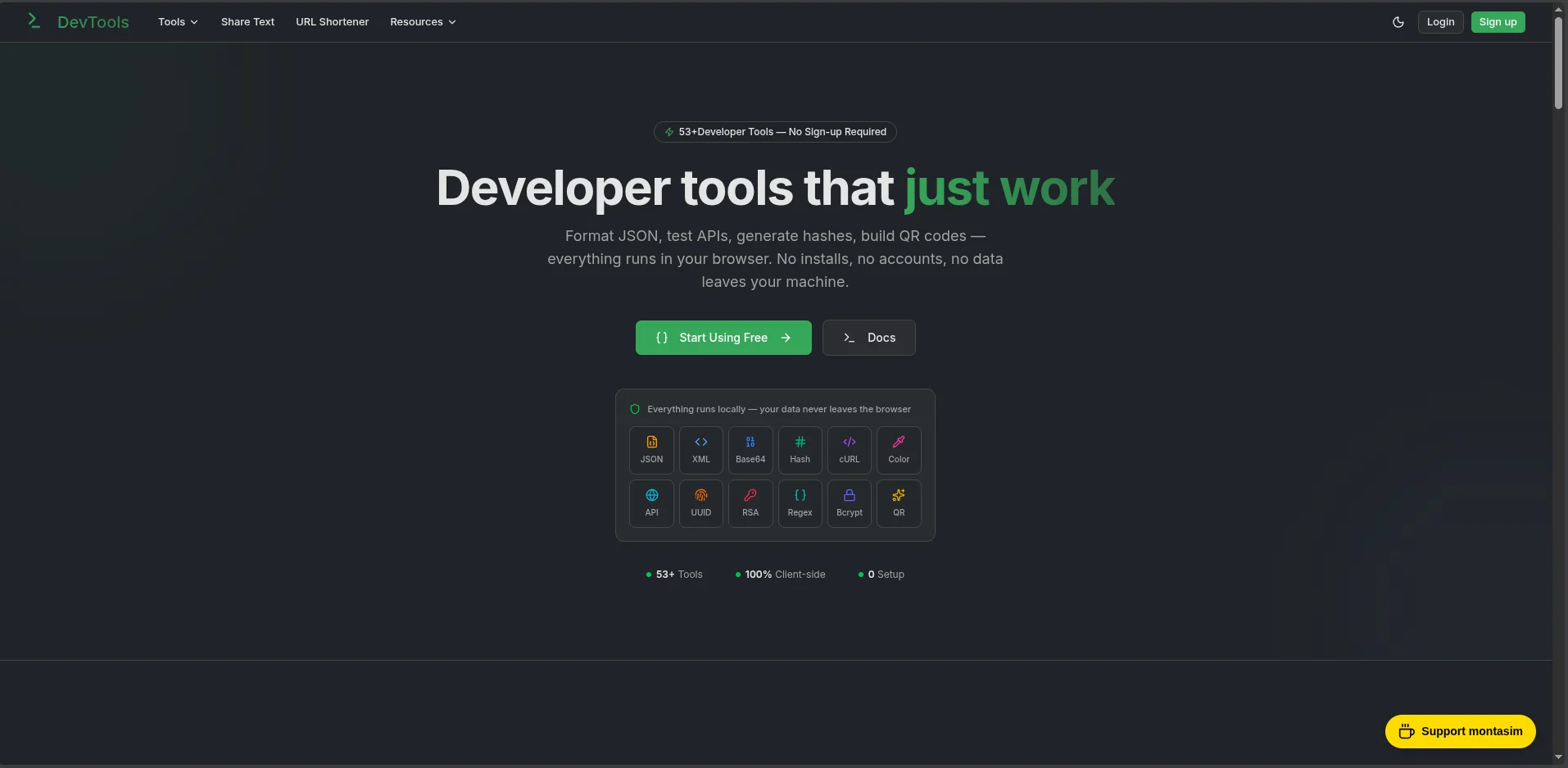
A comprehensive suite of 30+ free developer tools for formatting, validating, generating, and transforming data. All tools run entirely in your browser.
DevTools is a developer tool created to make a real workflow clearer, faster, and easier to trust. It turns a focused product idea into something people can use, evaluate, and understand without needing to inspect the source code.
Why DevTools exists
Small development tasks often send people across unrelated single-purpose websites. Each tool has a different interface, unclear privacy behavior, and no shared path for search, history, saved work, or reuse.
The goal is not simply to add another tool. DevTools is designed to reduce the friction around that problem and give people a more dependable way to complete the work.
What it delivers
- More than 50 workflows are available through one catalog and command-search model.
- Common transformations can run without an account and without sending their current input to the server.
- Server-backed features add reuse and sharing without obscuring when data leaves the browser.
- The architecture supports both small local utilities and stateful workflows without forcing them through one execution path.
The experience
A searchable toolbox of more than 50 developer workflows, with a deliberate boundary between local transformations and server-backed features.
The project brings the important parts of the workflow into one coherent experience. Its interface and behavior are shaped around the people using it, while the implementation stays focused on predictable results and honest feedback.
What to know
Every product has boundaries. These are the most important considerations for DevTools:
- Many transformations should stay in the browser, while network diagnostics necessarily contact a target or server endpoint.
- A catalog with more than 50 workflows must remain quick to search, navigate, and extend without duplicating page infrastructure.
- Saved items, shares, webhooks, and short links introduce authentication, expiration, and persistence concerns absent from local tools.
These limitations are presented openly so visitors can understand where the project works well, what it depends on, and what may change in future versions.
Current status
Actively deployed. The current release demonstrates the core value of the project and the main end-to-end experience.
My role was product design and full-stack engineering, covering developer utilities, shared interaction patterns, and account-backed tools. The related case study explains the decisions and delivery process in greater depth for visitors who want the engineering story behind the product.