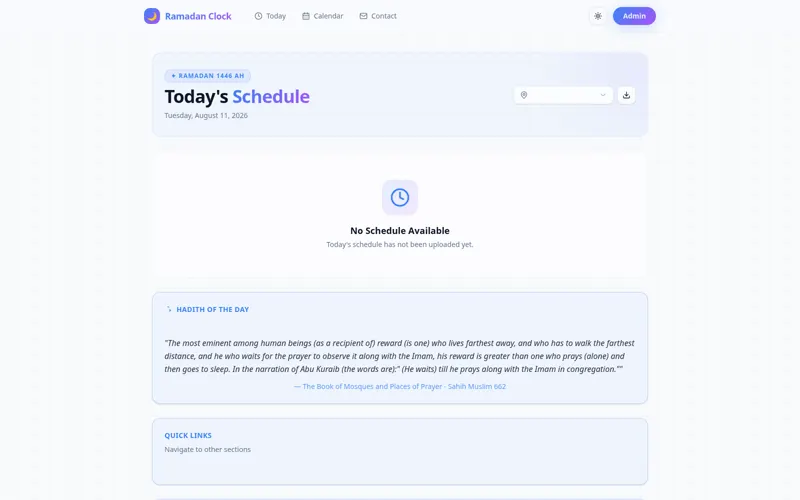
🌙 District-aware Sehri and Iftar schedules for Bangladesh, with PDF exports and protected timetable management. Next.js, PostgreSQL, Prisma.
Ramadan Clock is a web application created to make a real workflow clearer, faster, and easier to trust. It turns a focused product idea into something people can use, evaluate, and understand without needing to inspect the source code.
Why Ramadan Clock exists
Sehri/Iftar schedules need a clear local-time public view and an auditable maintenance workflow because external prayer-time sources, district selection, and timetable corrections can change the result.
The goal is not simply to add another tool. Ramadan Clock is designed to reduce the friction around that problem and give people a more dependable way to complete the work.
What it delivers
- Visitors can check daily and full Ramadan schedules.
- Administrators can import/fetch/manage location data.
- Duplicate/malformed records are rejected.
- Users can export schedules while seeing source/accuracy guidance.
The experience
🌙 District-aware Sehri and Iftar schedules for Bangladesh, with PDF exports and protected timetable management. Next.js, PostgreSQL, Prisma.
The project brings the important parts of the workflow into one coherent experience. Its interface and behavior are shaped around the people using it, while the implementation stays focused on predictable results and honest feedback.
What to know
Every product has boundaries. These are the most important considerations for Ramadan Clock:
- Calculated times depend on source, method, location, and local authority.
- External fetching requires retry/rate limiting and must not overwrite validated data indiscriminately.
- Duplicate date/location rows and malformed bulk imports must be rejected.
These limitations are presented openly so visitors can understand where the project works well, what it depends on, and what may change in future versions.
Current status
Pre-release application. The current release demonstrates the core value of the project and the main end-to-end experience.
My role was product design and full-stack engineering, covering product workflows, data boundaries, and delivery. The related case study explains the decisions and delivery process in greater depth for visitors who want the engineering story behind the product.